203) The Emotional Lessons I Learned From Getting My Ass Kicked
Chess seems to be a game of pure logic. Right? There is no randomness, in the sense of dice games or card games. There’s no bluffing and deception, like in poker. There’s no humour or extraversion, like in many board or party games. Chess is like a Vulcan, looking down its nose at all those silly, non-logical things, insisting that you discipline your mind so you can peer many moves ahead into a maze of pure calculation.
To train and improve is therefore relatively simple. Learn patterns. Learn strategies. Learn tactics. Learn openings and middle-game principles and endgames. Learn to think ahead. Learn to formulate a plan, and learn how to evaluate your plan against your opponent’s counter-play. Sure, it’s complicated, but it’s LOGICAL.
So I went into the Canadian Chess Championship well-prepared. My chess theory-knowledge was better developed than ever before in my life. My openings were solid and well-practiced. My middle game was at its thus-far best. Even my endgames had improved substantially. And online, my performance ratings placed me somewhere between about a 1500, and 2200, with my average performance hovering around 1750.
Now sure, 1750 is not National Champion material. Not by a long-shot. But it put me well into the top half of the competitors for the championship. Although I knew that I would likely struggle and stumble a bit, simply because of the pressure of competing in a tournament hall, rather than sitting on my couch playing online, I hoped I would have some kind of reasonable chance of, at least, giving my opponents competitive games.
I consulted with a GrandMaster before this tournament, going over some of my games and asking for advice. Her advice was very simple, if not what I was expecting — “You need to feel like you deserve to win.”
I thought, “Hmmm….um….ok.” So I “prepared” myself by getting into the competitive mindset, affirming myself when doubts would creep in, and otherwise trying to convince myself that indeed, I had worked hard, trained hard, and I DID deserve to win! I “believed” this. Or so I, errr, believed.
Then came the tournament. I won’t bore you with the excruciating game-by-game details. I had some strong games. I had some weak games. I had one truly horrendous game in which I played like I literally had never played the game before.
(It was, to my credit, the day after a near-sleepless night because I had a family member in the ER in medical crisis all night. By the evening, running on maybe 120 minutes of sleep, over 2 days, I simply could not think. So, yeah, that one was actually funny, it was so awful.)
But overall, medical crisis aside, I played poorly. My performance rating put me at about 1350, which is, in effect, playing HALF as competently as I normally play. (Chess ratings are scaled so that every 400 points is approximated to be a doubling of your chess skill, or so I’m told.)
I did win 2 out of 8 games. Yay me! But the 6 losses were very, very telling. It turns out, chess isn’t just a logical game, not when humans play it. And of course, the GrandMaster was right: I came into direct confrontation with my emotional preference for losing.
A Brief Foray Into Psychology
There is ample research in Psychology on how human decision-making and cognition is not actually “cognitive”, in the sense that we used to believe; humans do not process information in some logical, evidence-based way, even when we believe that we are.
Thus, when we estimate which players were more influential in a hockey game, or which team made the big plays, or which refs made the bad calls, we are HEAVILY guided by our biases towards the teams we like. Which is why fans of different teams ALWAYS see the game in very different terms, and unless it was a genuine slaughter on the ice, feel that their team “should have” won.
Just like when we estimate who is contributing more in our relationship, we estimate HEAVILY in favour of ourselves and feel like we are contributing more than our share. Even in “traditional” relationships, in which men will acknowledge that their wives do more of the housework than they do, they STILL overestimate how much housework they actually do. “Sure, my wife does 60% of the housework”, says the man who, in reality, does about 5% of the housework…..
Just like when we try to make judgements about politics, or who we should date, or whether the climate is changing, and we THINK we are thinking rationally, most of what we are actually doing is JUSTIFYING our emotionally-laden biases. We hear what we want to hear, see what we want to see, disregard what we don’t like, and conclude, after all our “careful thinking”, whatever we believed in the first place.
COVID, if anything, taught us this. Unless you REALLY believe that all the science was meaningless, masks do nothing to prevent the spread of respiratory infections, and Donald Trump’s advice to inject oneself with disinfectants, take an anti-malaria drug, or just get more sunshine, is better than the entire medical field’s. Otherwise, it was COVID made it pretty darn clear that humans have a heck of a difficult time believing things they don’t want to believe.
And if you do believe those aforementioned things, then I hear Jordan Peterson has more to say recently about how climate change science is all wrong, how “dominance” is the silver-bullet explanation for what makes people tick (just like lobsters!!), and how eating nothing but red meat is the cure-all diet. Evidence be damned.
Basically, when we think we’re thinking, much of the time we’re not really doing a whole lot of actual, logical, high-quality thinking. No, most of the time what we’re doing is cherry-picking and paying attention to the information we like (i.e., the information that agrees with us), and ignoring or rejecting information we don’t like (i.e., the information that doesn’t agree with us). Then, having “done our own research”, as the conspiracy theorists are always telling us they did, we come to the conclusion that, lo and behold, we were right all along! Yay us.
So what does this have to do with chess?
“You need to feel that you deserve to win”
When I look back at my losses, a very clear pattern emerges. First, I play fairly strongly for a while, and get into a pretty good, even winning position. Most of my losses (the sleepless one aside), follow that pattern. Then, in the thick of the struggle, somewhere in the early part of the middle-game, I choose a move that, objectively speaking, is horrible. And it’s not hard to figure that out. Just think about the move, and calculate ahead a little bit, and it’s pretty easy to see what moves are “probably ok” and what moves are like “hail Mary passes” — almost certain to fail unless your opponent is having a crack-brain-moment and kinda sorta just doesn’t notice what you’re trying to do.
In other words, in every case, I did something really, really dumb. Each time, I would think, about 2 seconds later, “D’oh! Why did I do that?”, and then after the game, I would chalk the loss up to “that one moment where I blundered”, as though it was just a moment of Bad Luck.
But the thing is, I made an analogous blunder in similar circumstances (i.e., in a strong position, mid-game), over and over. Why did I do this? Why did I play, on average, so much worse than I play online?
Because the GrandMaster was right. I do not FEEL like I deserve to win, and the more my SELF is involved in the situation, the stronger those feelings of not being deserving, become.
I can THINK that I deserve to win. But my FEELINGS are different. In fact, the closer I get to winning, my emotions become a maelstrom of chaos. I don’t even know what I’m feeling in those moments. Just…”squirrelly”. And needless to say, squirrels suck at chess. (I assume!)
In contrast, when I’m at home, sitting on my couch playing chess online, my “self” is not much involved in the process. I’m basically anonymous, as is the other person, and I’m just moving pieces around on my screen. The “pressure” is about as intense as playing solitaire. I.e., there isn’t any. And winning just feels satisfying, pure and simple, like solving a puzzle or beating The Boss Monster in a video game. And losing feels…interesting, like, “hmmm, let’s see what the chess engine tells me I did wrong so I can learn from it.” There’s very little “rush” of victory, and little-to-no “crush” of defeat. It is, after all, just a game.
But in a national championship tournament, sitting in a Great Hall with hundreds of other players, competing to DESTROY the stressed-looking person sitting across the board, while people mill about, watching the game over my shoulder, is a very different situation. My “self” is most definitely involved. And THAT self feels REALLY uncomfortable with winning. Like I’m being selfish and should feel ashamed of myself.
The emotional processes of making dumb decisions at the chess board
As best as I can intuit from my experiences at the board, I think there were two key emotionally-driven processes that tanked my play in key moments.
One was the simple cognitive load of feeling evaluated. This is classic “choking under pressure” that you see in sports all the time. It’s the brain-sluggishness, when you’re writing an exam and the teacher is standing behind you looking over your shoulder. It’s why the basketball player can sink free throws in practice, no problem, but misses the shot during “the big game”. It’s why your otherwise hilarious friend becomes a boring, stilted, monotonic sleep-inducer when they try to give their class presentation.
Psychologists have terms like “cognitive load”, and “evaluation apprehension”, and things like that, to help explain why we under-perform when we are feeling particularly “put on the spot”. These are related to other processes, like “stereotype threat”, in which members of a stereotyped group will under-perform when their group-membership becomes salient for some reason, such as a woman writing a math test with a group of men. There are a variety of mechanisms by which heightened evaluative self-consciousness interferes with performance, but for me personally, it’s a combination of feeling confused and sluggish, feeling the need to DO something dramatic in order to “prove” myself, and just generally feeling “foggy”.
But whatever the specific processes, when our evaluative self-consciousness is activated, our emotions get cranked up, and our ability to think and perform well, takes a beating.
This is pretty straightforward; everybody understands this. And the solutions are relatively simple. Basically, learn to calm yourself down in-the-moment, learn to identify and “breathe through” feelings of anxiety, and practice practice practice so that you automatize good patterns and can carry them out successfully even under conditions of “high cognitive load.” Easy peasy.
So for me, there are some lessons to be learned there. In the future, I need to be more mindful of my anxiety and self-consciousness during competitive play, and practice the emotion-regulation things I am familiar with, to calm myself down and allow myself to just focus on the game.
However, that’s only one part of the challenge, and I believe it’s the smaller part. The bigger issue wasn’t of simply not being able to focus and thus under-performing. No, the Big Issue was that I INTENTIONALLY CHOSE poor, risky, unlikely-to-succeed moves, even though I knew better! It wasn’t simply “making a mistake”, although sure, I did that too. But the real issue was convincing myself that I had to try something out-of-the-ordinary, something risky; I had to surprise my opponent by doing something “outside the box”. (Which in chess, usually means you lose.)
Why would I do that?
“You need to FEEL like you deserve to win”
As we all know by now, the roots of our struggles are typically formed during childhood. Bad shit happens when you’re a kid, and you don’t have the defences and intellectual sophistication, yet, to make sense of things. So you blame yourself. Or you’re mistreated by people who are caring for you, and again, you don’t have the defences and intellectual sophistication to realize that it’s not you, the child, with the problem, but them, the adults, who are mistreating you. So again, you blame yourself. And if you are told explicitly, by people you trust, like your parents, that you are stupid, ugly, a loser, useless, etc., then generally, you take that in and it BECOMES your self-concept.
By the time I was 15 and moved out from a very abusive home, I thoroughly, thoroughly hated myself. I had been well-trained by the adults I was living with, to believe that I was responsible for the problems in the family. I was told literally countless times that I was “dirty”, “disgusting”, “filthy”, “stupid”, and “useless”. I wasn’t allowed to enter the living room, or use the hot tub, or answer the phone, because of those reasons. The phone was the most humiliating; apparently, according to my step-mother at the time, “everyone in town” thought I “sounded like a retard”, and it was too embarrassing for my parents if I answered the phone, so I simply wasn’t allowed to.
But for some reason, the hot tub really stands out for me in my memory; there was just something so obviously WRONG about the fact that everyone in the family used the hot tub, that my step-sister had her friends over for hot-tub parties, and that for all the years we lived in that house, I never once stepped into that tub. It was “for other people”. Not me. I was too “disgusting” and “filthy”, like somehow “filth” was built right into the very cells of my body.
Similarly, the things I loved, particularly soccer at the time, I wasn’t allowed to do. Sure, I could go to practice, but I could never be part of the team. That was “for other people”. So, for three years, I went to soccer practice, biking the few kilometres to practice every week. But in all those years, I only once played an actual game. (Can’t remember why I was allowed to do so that weekend, but it stands out as the only actual soccer game I ever played with my team. It might actually have been because I was staying with a friend that weekend; I don’t remember.)
Similarly, the things I tried to do in school, I was ridiculed for. I remember bringing my stories home from school, very, very proud of them. And they were burned, literally burned, in the furnace. I’m not sure why; I guess it was perceived that I was being “arrogant” or something, bringing my stories home for my parents to read, so they burned them instead of reading them.
I remember sitting in my room in grade 8, reading my first book on neural-feedback (i.e., brainwave research, showing how different states of consciousness have different measurable brain-waves associated with them, and through biofeedback techniques, people can learn to alter their own brainwaves, etc.), prepping for the year-long project in a class I was in. When my step-mother discovered what I was reading and took a look at the book, I was ridiculed, because clearly I was “too stupid to understand this”. And so, I gave up, and did a woefully uncreative project on how to maintain a motorcycle. (Basically, I copied the owner’s manual of my dirt-bike and handed it in as my project, feeling utterly ashamed that I was “too stupid” to be able to think of anything better.)
And medical things, I’ll truly never understand. I remember being in the hospital when I was 10, for five straight days and nights, and was never brought a toothbrush or any toys to play with. Like….huh? Not even a toothbrush? Who the fuck does that??? I remember being run over at 14 and having my back nearly broken. For some reason, I was never taken to the hospital or to see a doctor. When I finally went, about 15 years later as an adult with chronic back pain, and the requisite scans were done to show the damage to 6 of my vertebrae, the doctor was simply flabbergasted that this was the first time I had been checked out. They tried to understand why I didn’t go to the hospital when the accident happened because clearly, I must have been in considerable pain. And yeah, I don’t know why. I just lay in bed for a few days until I was able to get up and get back to life. My parents did not seem to think it was important? I don’t know; I really don’t.
I don’t understand most of these things. I most certainly didn’t understand them at the time. But I most definitely internalized their implicit message — “You do not matter. You do not deserve to be taken care of.”
That was 36 years ago. And while I have tried to grow and heal past those years, it’s like the proverbial experience of peeling-an-onion — you heal from some layers of trauma, but then, it goes deeper and deeper and deeper.
For all my life since, I have struggled with basic self-care. It’s difficult to describe to people who have not had these experiences, how pervasively they affect your life. For example, one of my biggest early-growth moments was when I was about 30, just finishing my years in grad school. And I FINALLY took the step of allowing myself to eat fruit.
Seems ridiculous right? Eating fruit? What’s the big deal? Why didn’t I eat fruit for, like, 20 years?
Well, when you feel like the “good, healthy food” is for other people, because you are repeatedly referred to as the family “garbage can”, and if you take fruit from the fruit bowl then you are “being selfish”, then you grow up not eating fruit. Fruit is like, “special” or something, and it’s not for you to eat; like hot tubs, fruit is “for other people”. Simple as that.
So yeah, eating fruit was a big step. Took me 20 years to feel ok about that. Hot tubs took a much longer time. In fact, aside from two extremely drunken moments of being in a hot tub somewhat inadvertently, I never overcame my “weird feelings” about hot tubs until this past fall (September, 2023). I was at a women’s healing retreat, and there was an outdoor hot tub that people were going to use at night, under the stars of a clear Muskoka sky. It sounded lovely, and after all, this WAS a healing retreat; it you can’t “heal” at a healing retreat, then sheesh, when are you going to get around to it?
So I mustered my courage, swallowed my shame that I was doing something I wasn’t “supposed to”, and, feeling quite ridiculous like I did NOT deserve to be there, I joined the other women, settled into the steamy water, looked up at the stars and felt something I have almost never felt. I felt, for those moments, like I belonged.
Simple as that; I just belonged. I was “allowed” to have nice experiences too! I was allowed to join people in doing fun things! I …. belonged. When I got back to my room a while later, stripped down, dried off and got ready for bed, I felt like crying. But I was past even that. It was more like being in shock. So I just went to bed, feeling incomprehensibly grateful, and slightly guilty that maybe I shouldn’t have done that after all. But mostly, feeling wonderful.
Dressing nicely was an even bigger challenge. After being told for so many years that I was ugly, that I looked “stupid”, that even as we’d be going to church in our “Sunday best”, I would be scoffed at in frustration by my step-mother, because “what is WRONG with you? You can’t even look good in a suit”, I had internalized a deep belief that no matter how hard I tried, I would always look horrible. So, I stopped trying.
I never figured out how to dress attractively until also this past year, at 51, after fully transitioning to living as a woman. Something magical happened when I wasn’t “Dan” anymore; all of a sudden, I WANTED to look nice, WANTED to take pride in my appearance, and ENJOYED the feeling of walking down the street feeling like I looked my best. But living as a man? Nope, for almost four decades, I felt really, really uncomfortable whenever I dressed up and looked nice, whereas I felt “safe” when I looked like I had just rolled out of bed and put on whatever was on my floor.
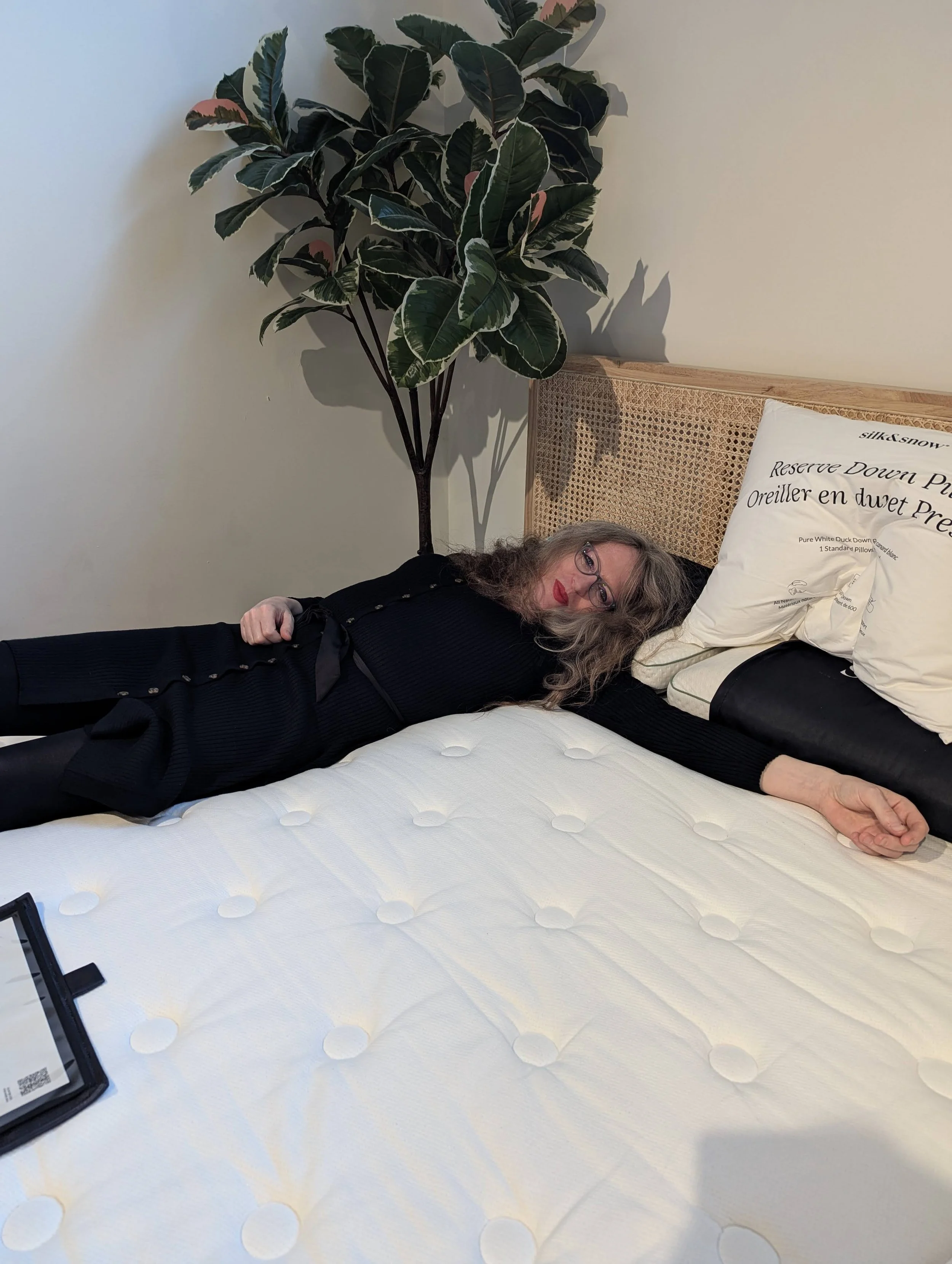
Similarly, the “little things” that people buy, to make themselves feel good? Yeah, that was never for me. I convinced myself I was “anti-materialistic”, and just didn’t need “things”. Then my girlfriend, this past fall, bought me cute pyjamas (the ones in the picture above). As soon as I unwrapped them, I was thrust into instant turmoil and emotional conflict. Partly, I felt WONDERFUL!! Like, how cute! How nice of her! How thoughtful! And OH MY GOD I HAVE CUDDLY PYJAMAS NOW??!!!!!!
But the rest of me was reacting with embarrassment, shame, guilt, feeling like I had done something wrong, feeling that I didn’t deserve them. After all, I’ve gone to bed for my whole life wearing either my clothes, or….well….”NSFW”…. Who needs cute pyjamas anyway? Isn’t that just being indulgent? Selfish? And part of me felt horrible that I couldn’t just react positively and with gratitude for getting a present!! So I did my best to just react with excitement, hoping she wouldn’t pick up on the ambivalence.
She did anyway. I ended up crying. And then had the experience of being ACCEPTED and cared for, even though I was allowing someone to see me in distress. It was like….what? You WANT to actually be here for me? ….. What??
But yes, I fucking LOVE my pyjamas. As spring is warming up, they are becoming too warm. But, hehe, she bought me cute summer PJs too, so it’s all good…. And recently, she learned to sew and make her own pyjamas. The future looks very cuddly indeed!
Vacations? Haven’t overcome that one yet. The whole idea of planning for a vacation, feeling like I “deserve” to be able to spend that money to go somewhere awesome and have great experiences — is just so alien to me that I haven’t been able to do it. I’ve literally never, once, gone on vacation other than just going camping somewhere, with one exception of a drunken party-trip in high school that I took with friends. And with a couple of exceptions of traveling somewhere for an academic conference and seeing some sights while I was there. But without it being either an extension of self-destruction, or something I could justify as “work”, I have never travelled somewhere for a vacation.
When I’ve tried, or a friend has suggested we go somewhere on a trip, the guilt, the feeling of unworthiness, the feeling that I’m being selfish, hits IMMEDIATELY. And one way or another, I make sure it never happens. …. I know, shitty, right? I can imagine I have been extremely frustrating for people…
I could go on. The examples of how life is shaped when you feel, deep down inside, that you do not deserve good things, are endless.
Trauma-activation at the chess board
But this is supposed to be about chess! So how does all this play out during a chess game?
Well, there are clues in these other experiences. For one thing, it’s NOT the case that you sit there in a winning chess position and then think to yourself, “Gee I don’t deserve to win; I guess I’ll fuck everything up now.” It’s not intentional like that. It’s more, like I was saying earlier, that you feel confused, your brain gets foggy, things start to seem really complicated and difficult-to-think-through, you start to wonder whether your opponent is sitting there thinking you are stupid, you start to wonder if the others standing around watching your game are thinking how stupid you are, and so you kind of “lash out” at reality, trying to assert yourself through a bold, dramatic move. As a result, you choose a poor move, and….you lose.
It’s kind of like, if you are uncomfortable asserting yourself, then you will find it VERY difficult, say in a relationship, to tell your partner how you’re really feeling, unless of course you are feeling hunky-dory and A-OK. But if you actually are feeling dissatisfied about something, if you feel your needs aren’t being met, then whoa Nellie, you are going to have to STAND UP FOR YOURSELF. Yikes!
So you put it off, and put it off, and put it off, until the time comes when you just can’t ignore it any longer. You NEED to speak up.
And what happens then? Well, you gather your courage, you confront your partner, and …..you speak up. Unfortunately, by the time you’ve gotten this far, you’re so anxious and feeling guilty and hyper-aroused (not in the good way), and generally stressed, that you come across WAY MORE EXTREME than you intended to! You THINK you’re just being straightforward and honest and trying to do the difficult thing and unburden yourself of what’s been bothering you, but to the other person, you seem angry, or cold, or like it’s a “huge problem”, or in some way or another, it’s like you’re overreacting and making things out to be much worse than they are. And you’re not!! At least, you’re not trying to! But your bodily-hyper-arousal in the moment of confrontation, sabotages your ability to have a direct, calm, skilled discussion.
Like I said, in the moment you’re not generally aware of these things. Like at the chess board, I’m not aware that I’m feeling unworthy of winning the game and I’m starting to think of insane “strategies” that actually don’t make any sense. No! I’m still “trying my best”, but unbeknownst to me, my ability to think logically has nose-dived and been replaced by some desperate sense of being in a desperate situation.
In short, it’s not my ability to think logically that failed me. It was my emotions getting in the way, telling me the situation was far more dire than it was, and often, thinking that “everyone around me” was thinking I was some kind of moron. But unaware of these emotions, in the moment, I couldn’t control for them very well, and instead, my mind just kind of unravelled.
This lack of overt cognitive awareness is why, when the GrandMaster initially told me I needed to feel like I deserved to win, I didn’t get much from the advice. Because it’s not like I sit there and THINK “I don’t deserve to win”, or otherwise consciously sabotage the game.
It’s more like how, when you like the pretty girl in your class (or whatever form of human you’re into), but you feel too embarrassed to ask her out, so you just don’t. MAYBE it crosses your mind, as some sort of “gee, I sure wish…”, but then you reject it out-of-hand as an impossibility.
And what happens if you DO overcome this, muster the courage to approach her and try to strike up a conversation? Well, like with the relationship confrontation example above, you likely end up so over-anxious in the moment that your brain turns to mush, you get flustered, and you behave like a total fool, put your foot in your mouth and say something stupid, or default to super-awkward humour, or get all cringey with self-deprecations and apologies for everything. One way or another, you mess it all up. And THEN tell yourself you’re certainly never doing THAT again.
In other words, anxiety happens, and it fucks everything up.
And THIS is exactly what happens at the chess board. I’ll be in a strong position, and then….something happens….and my ability to think strategically just goes out the window. I stare at the board, trying to find good moves, and it’s all a big incomprehensible mess. I try to think tactically and look at combinations that will give me an advantage and….nothing. My mind slows down and turns to sludge. And then, I convince myself that it’s basically hopeless and I have no options, so I choose the high-risk “hail Mary pass” type of move. And that’s it, the game is lost.
Interestingly, AFTER that moment, I play generally quite well. When I’m losing, I have no difficulty concentrating, thinking deeply, trying to find a clever way out of it. But when I’m winning, my mind turns into….a plant.
So, I had hoped that in taking part in this championship, even though I expected to lose most of the games, that I would at least have excellent games to look back on and analyze and learn higher-level strategies from. But those excellent games didn’t really happen. There’s not much “chess” to learn from how I played, except “don’t do that.”
Instead, I learned an even more valuable lesson. I learned how important deep-seated emotions are for undermining success. I learned how childhood shit still pops up, even decades later, and robs one of new experiences.
I learned how, even in as seemingly logical a challenge as chess, we are still highly emotional creatures, and if we don’t have our emotional ducks-in-a-row, we are going to sabotage ourselves, without even intending to.
I learned that to improve my game, to really improve my game, I have to first FEEL like I deserve to.
So, it turns out, in the end, that training for competitive chess, is not much different from “training” to live a good life. Step 1, is to heal.
So I’m focusing now not so much on chess strategies, but on emotions.
The Ontario open chess championship is in about a month. I plan to take very good care of myself, to practice good emotional skills, to practice self-compassion, and to really focus on “the work” of cultivating a more harmonious, accepting, and indeed, loving relationship with myself. After all, I’ve conquered my resistance to fruit now. Nice clothes. And speaking up for myself. Now, it’s learning that I am allowed to win.
So in a month, THAT girl will sit down at another series of chess boards, with another group of opponents and…
….we’ll see what happens!