321) So you want to be a Dungeon Master? Lesson 1: World-building and Plot Visioning
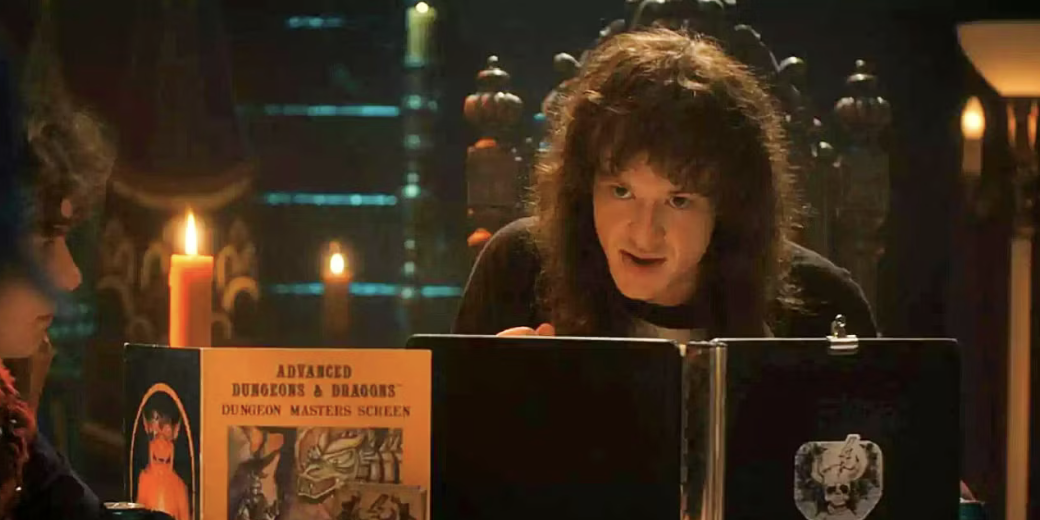
- Eddie Munson, the Dungeon Master from Season 4 of Stranger Things
How do you create a D&D campaign? How do you manage the complexities of plot, characters, world-building, combat, treasure AND the bizarreness of what the characters decide to do (which, inevitably, will diverge from your expectations and careful planning…)? How to make all this manageable and not overwhelming, and not ENTIRELY life-consuming?
Here’s what I’ve learned from 40 years of Dungeon Mastering. May it be of assistance.
* * * * *
The Adventure Idea: How do you come up with one in the first place?
This is something that can stump people right off the bat. It’s like writer’s block, when the dreaded BLANK PAGE becomes an unconquerable foe, because every idea you have, everything you start with, seems stupid. You’re trying to come up with the next Epic Tale, the next Lord of the Rings, the next fully-detailed world like Middle Earth, and … you just can’t.
But take heart! Trust your imagination. And cut yourself some slack. The point isn’t to come up with some Epic Tale all at once. The point is just to get started. The ideas will build on themselves.
***One of the most important things to learn as an aspiring Dungeon Master is that coming up with an OVERALL adventure idea (and the complete world it is set in) is NOT NECESSARY.***
Coming up with sub-adventure ideas, mini-adventures, something-to-do-that-would-take-a-single-play-session, is good enough to get started.
Similarly with world-building; all you really need is the local area around your characters. That’s good enough to get started. Of course, if you have sketched out major kingdoms, maybe a short backstory about the Big Picture of your world, that’s cool too. But it’s not necessary. You can always build that into the adventure as you go.
Besides, how much are the characters likely to know about the world? Most people don’t know everything about the world they live in. Especially in the pre-internet ages; people might live their whole lives and know very little about the Entire World outside their little village. So why should adventure characters be any different? It makes perfect sense that they only know their own little slice of the world, their own village or city and the local news relevant to their own lives.
Like the Hobbits; most of them knew practically nothing about life beyond the Shire! So start with your own “Shire”, and figure out other stuff as it becomes relevant.
* * * * *
The Plot
The insight about world-building also goes for plot-building. You don’t need some fully detailed plot with all the twists and turns figured out in advance. (Besides — BOOOORING!!!!) Just start with where the characters are at.
For example, if you’re just getting started, and the characters are first level, then “the plot” is simply whatever you need to get them started on an adventure! Think of the FIRST goal or mission that could get them to start adventuring.
Maybe they’re bored and want to “see the world”. Or maybe they decide they want to find a Unicorn and tame it. Or maybe they want fame and fortune. Or maybe there’s an abandoned ruin on the outskirts of town. Or a secret cave that some villagers went missing in recently. And off they go!
You can let the characters themselves decide, if you prepare a few basic ideas to use as “seeds”. Get the characters to take on odd-jobs around town to earn some money for equipment, and on the job, one of their co-workers gossips about — [insert adventure idea here].
Or the characters check out the local bulletin board and see what tasks are available for a courageous soul. Or they go into the local tavern and chat up some of the patrons to hear the local gossip. Or they’re wandering around the market square one day looking for a cheap lunch, and the town crier shows up and announces the latest news.
You don’t need a super-complicated, years-long Quest for something Epic and Legendary. Starting adventures can be super-simple.
One of my favourites was two characters (with an NPC) being hired to provide an armed escort to an ice-cream-maker’s delivery to a nearby town. They had to complete the mission within a specified time frame, like a day, or the mission would fail because the ice-cream would melt. So off they went!
Other starter ideas:
- Rescuing someone important who has been kidnapped is always good, and provides a short-term mini-adventure, a narrow plot at first to limit the complexity of planning, and a reward at the end of it.
- A haunted ruin that some previous adventurers disappeared into and didn’t come back.
- Attacks on the edge of a city from creatures coming out of the swamp/forest/caves.
- A local mage could hire them to go into the forest to find some magic potion ingredients.
- A spy mission that some rich or politically connected person hires them for, using them as pawns in their overarching chess game of political intrigue. The characters can be tasked to spy on a specific person and find out some specific piece of information (e.g., Who do they meet with on their late-night expeditions to the forest? Who are their poker buddies? Who are they having an affair with? Where do they keep the key to the locked door to their cellar? What are they hiding in that cellar?
Etc.
Note: I started a D&D campaign with my kids when the youngest were about 6 or 7. Not wanting to marinate my children’s minds in hack&slash violence, we started with a spy mission. Now it’s 12-13 years later, and the campaign continues, having grown into an entire epic….
You can make this super-small scale for a couple of play sessions, or make it a mini-adventure on its own. But the point is that it gets the characters started, gains them some experience, gives them some treasure or payment at the end of it AND IMPORTANTLY, lets you insert further details of intrigue that lead to the next adventure.
They might find clues like a secret note or a discarded diary; they might talk to some lost bloke around a campfire some night; they might hear screams coming from over yonder and decide to go check it out; they might come across a tree nymph weeping because some Bad Guys have threatened to cut her tree down; they might meet an ally on the same mission as themselves (or someone pretending to be an ally who will later betray them…); they might get some of their stuff stolen while they’re sleeping and decide to track down the thief. The possibilities are endless.
So yes, you don’t have to start with something grand. And in fact, it often makes sense not to anyway, because at the beginning, characters are low-level and why the heck would THEY be the ones to do something “legendary and world-changing”? That’s for higher-level characters to get involved in. Although the low-level mini-mission can give them INFORMATION about the higher-level shenanigans going on in the world…..
THE KEY is to string together encounters, scenarios, mini-adventures, etc., so that one things leads to another. It doesn’t have to appear pre-planned, like some hermeneutically sealed plot of perfect intertwining. Things just need to connect, somehow.
* * * * *
EXAMPLE OF BEGINNING AN ADVENTURE
Start in town. Narrate that they are bored, tired of living on their farms or working in their parents’ shops, and they want to start adventuring but they don’t know what to do. Have them brainstorm — “how will you find out some gossip or information in town about adventuring opportunities? And then go with whatever ideas they come up with.
They’ll probably go to a tavern, or the library, or the town market. But almost always, a tavern. Awesome. As they do some good ol’ fashioned drinking and bribing people with drinks, they’ll find out some juicy gossip.
One piece of gossip could be a story about the Crazy Old Hermit, the guy who used to call himself Nebuchadnezzar or something, and everyone in town, a few years back, used to know about him and think he was either crazy or a genius or both. Then he died and a letter was found, addressed to “All you fine people in [name of town] who want to live grander lives than your currently pathetic existences”, and it went on to describe his treasure that he hid somewhere in The Swamp.
Lots of people, of course, went looking for the treasure, to no avail. But just the other night, when she was drunk one night, his former nurse told her friends that, as he was dying, he whispered to her “The Key is in the Old Emerald Mine”, an abandoned mine about a league outside of town.
So off the characters head to the mine.
While there, you can insert side adventures as much as you want.
- They could meet other people who are also searching, and glean information from them. Or start a rivalry. Or make allies.
- They could be hired to find a lost adventurer from a party who lost someone important to them and is giving up the Quest but wants their comrade rescued.
- They could encounter a mysterious nymph who says she knows where the Key is, but she’ll only tell the brave souls who will rescue her part of the forest from the evil logging company that’s cutting all the trees.
- They could come across a farm that’s been lit on fire, and they rush over to see if they can help, whereupon they find out there’s a criminal gang extorting payments from farmers for “protection”, and gee whiz, it sure would be good if some heroes would come along, A-Team style, and help the poor local farmers from these Bad Guys!
- Some bandits, or goblins, or harpies, steal a bunch of their stuff in a midnight raid, and they need to track them down and recover their equipment. Whereupon, in finding their camp, they discover a prisoner, all trussed up and ready to be roasted. By rescuing the prisoner in an epic well-planned ambush (characters love planning ambushes; I think it’s a universal human trait), they find out she’s the niece of the rich nobleman, Count SnootyFace in town, and he paid these bandits/goblins/harpies to take her away, make it look like a kidnapping, and get rid of her, because she had discovered that he was having an affair with the banker’s wife, and if his own wife found out, she would divorce him and take half his estate. So to protect his wealth and reputation, the niece had to go.
(So now characters know about a rich nobleman, and have dirt on him. Maybe they’ll decide to blackmail him at some point. Or, who knows?)
In any of these twists and turns, they might decide to pursue this new path, or stick to the original mission, and shelve this information, for now, perhaps to be pursued later.
* * * * *
One of my favourite examples of this, from a campaign with my kids, was that when their characters were about 3rd level, they were looking for a secret entrance to this criminal hideout, and in the course of searching, they discovered the lair of a White Dragon, that was rumoured to be filled with treasure. Of course, they couldn’t risk encountering a dragon. But now their characters knew where it was.
Sure enough, about 5 years later (in real time), when their characters were 11th level, they decided to head back to that area and check out the Dragon lair. This lair was COMPLETELY IRRELEVANT to the original story, just a side detail. But half a decade later, it became an entire adventure of its own.
* * * * *
So now you have a Quest (find the Treasure in the Swamp), that requires a sub-Quest (find the Key in the mine), that allows for innumerable side-quests, allies to be found, enemies to be made, etc. And it’s all connected.
Which leads to the next question, and one of the most difficult parts of DM-ing — ***Planning*** without losing your damn mind and sacrificing your entire life to it.
To be continued….